Climate & Global Change Center Workshop: Bridging perspectives between enhanced rock weathering and critical zone science, April 27-28, 2026

The Climate & Global Change Center at the University of Pittsburgh held open sessions that examined intersections between enhanced rock weathering (ERW) and Critical Zone science. This convening brought together geochemists, soil scientists, hydrologists, ecologists, and modelers from academia and industry to identify shared concepts, methods, and knowledge gaps that limit progress on ERW as a carbon dioxide removal (CDR) strategy. Sessions explored the mechanistic controls on mineral dissolution and carbon turnover in regolith, the role of biological and hydrological processes in modulating weathering rates, best practices for field estimation of CDR, and approaches to upscaling site-level observations to landscape and regional models. Participants reviewed monitoring protocols, uncertainty quantification, and data integration techniques that can reconcile short-term experiments with long-term Critical Zone evolution and CDR.
Presenters:
Dr. Evan Ramos [University of Pittsburgh]: Clays as carbon capacitors: How resolving the rates and mechanisms of clay mineral
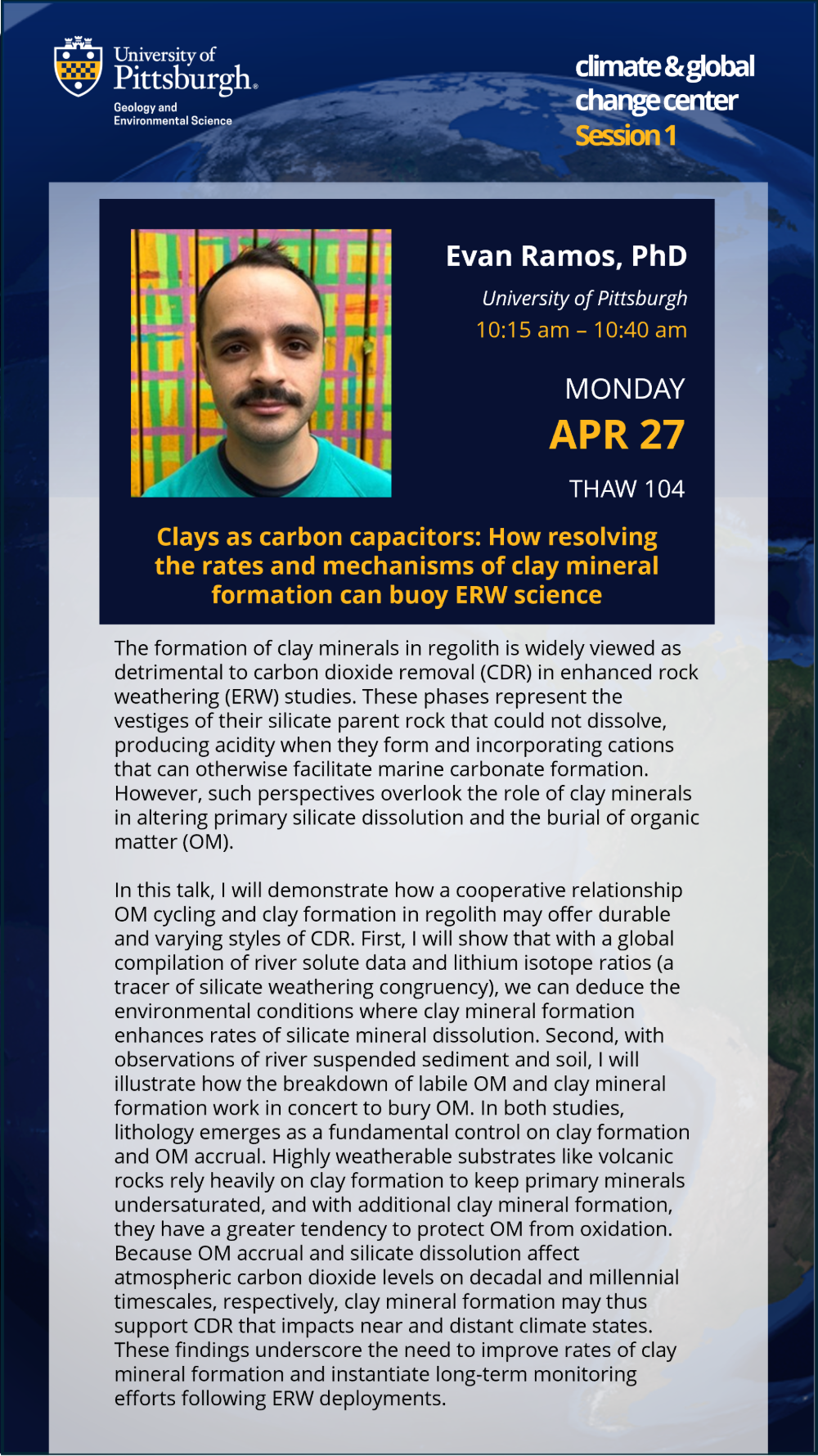
Dr. Noah Jemison [University of Pittsburgh]: The influence of secondary minerals on silicate dissolution and alkalinity generation

Sebastian Muñoz [Brown University]: The interplay between primary mineral dissolution and secondary mineral

Dr. Yi Hou [ETH Zurich]: Chemical weathering in the Kasai River Basin and implications for ERW in the tropics

Dr. Alison Tune [Cascade Climate]: Using watershed studies for ERW: A discussion on growing the evidence base

Dr. Jon Golla [TerraDot]: Translating insights from critical zone science to reconcile reaction and transport timescales in the enhanced rock weathering near-field zone

Dr. Amanda Donaldson [University of Texas, Austin]: Catchment processes missing in enhanced rock weathering: lithologic heterogeneity, non-perennial flow, and hillslope connectivity

Dr. Preston Kemeny [WHOI]: Framing the impacts of chemical weathering on pCO2 through contour-crossing calculations

Dr. Gavin Piccione [Brown University]: Surface Albedo Changes from Enhanced Rock Weathering: Insights from an ongoing field experiment

Dr. Tyler Kukla [CarbonPlan]: A critical zone model walks into a market

University of Pittsburgh, Department of Geology & Environmental Science Colloquia, Spring 2026
Dr. Steve Meyers [Vilas Distinguished Professor, University of Wisconsin-Madison]: Astrochronology: Using Earth’s Astronomical Motions as a Geological Timekeeper and Planetary Decoder - Jan 15, 2026

Dr. Katherine French | Research Chemist, U.S. Geological Survey: Integrating inorganic geochemistry to elucidate the occurrence of euxinia and organic sulfurization in the geologic records - Feb 05, 2026

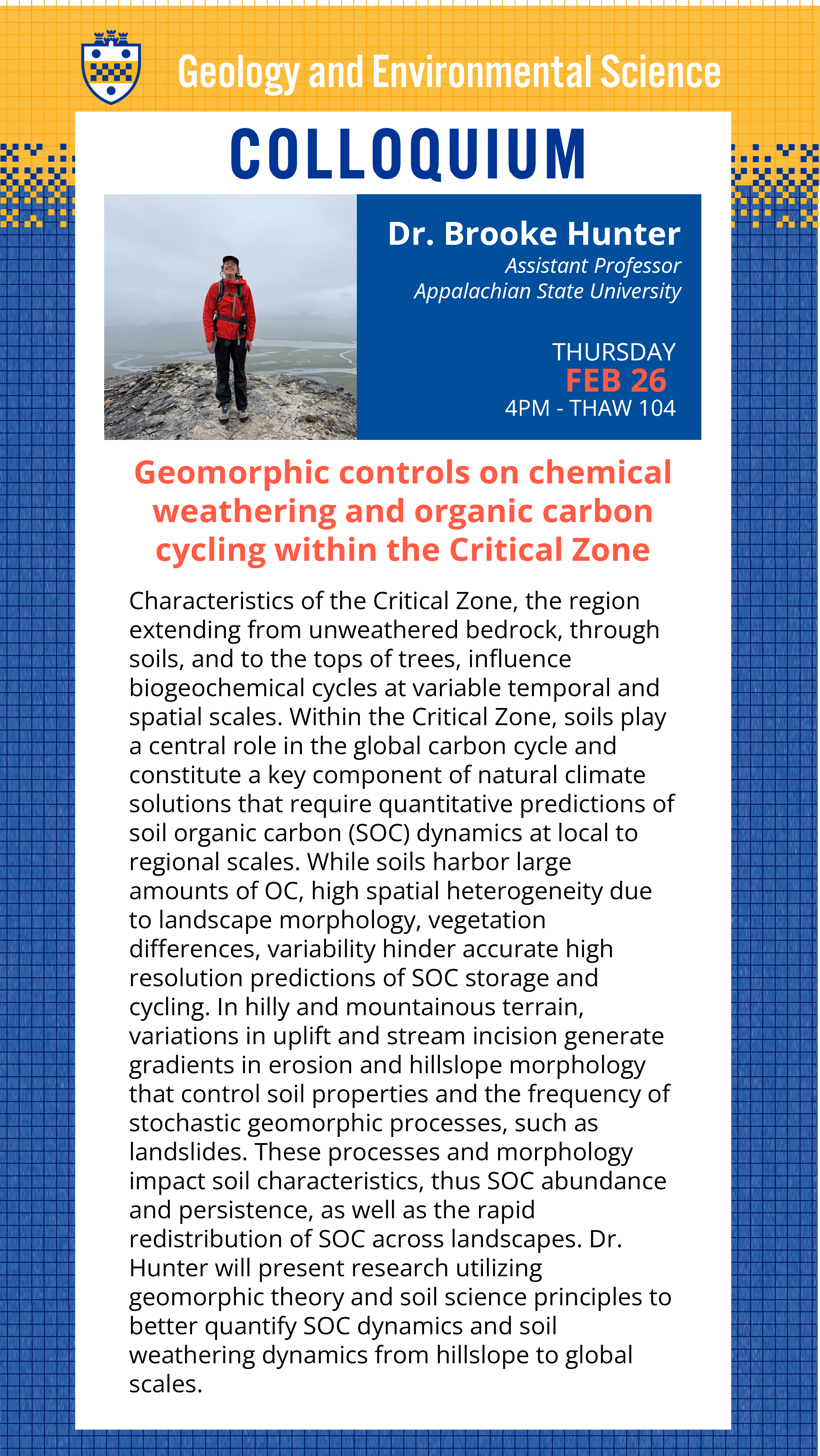
Dr. Brooke Hunter [Assistant Professor, Appalachian State University]: Geomorphic controls on chemical weathering and organic carbon cycling within the Critical Zone - Feb 26, 2026
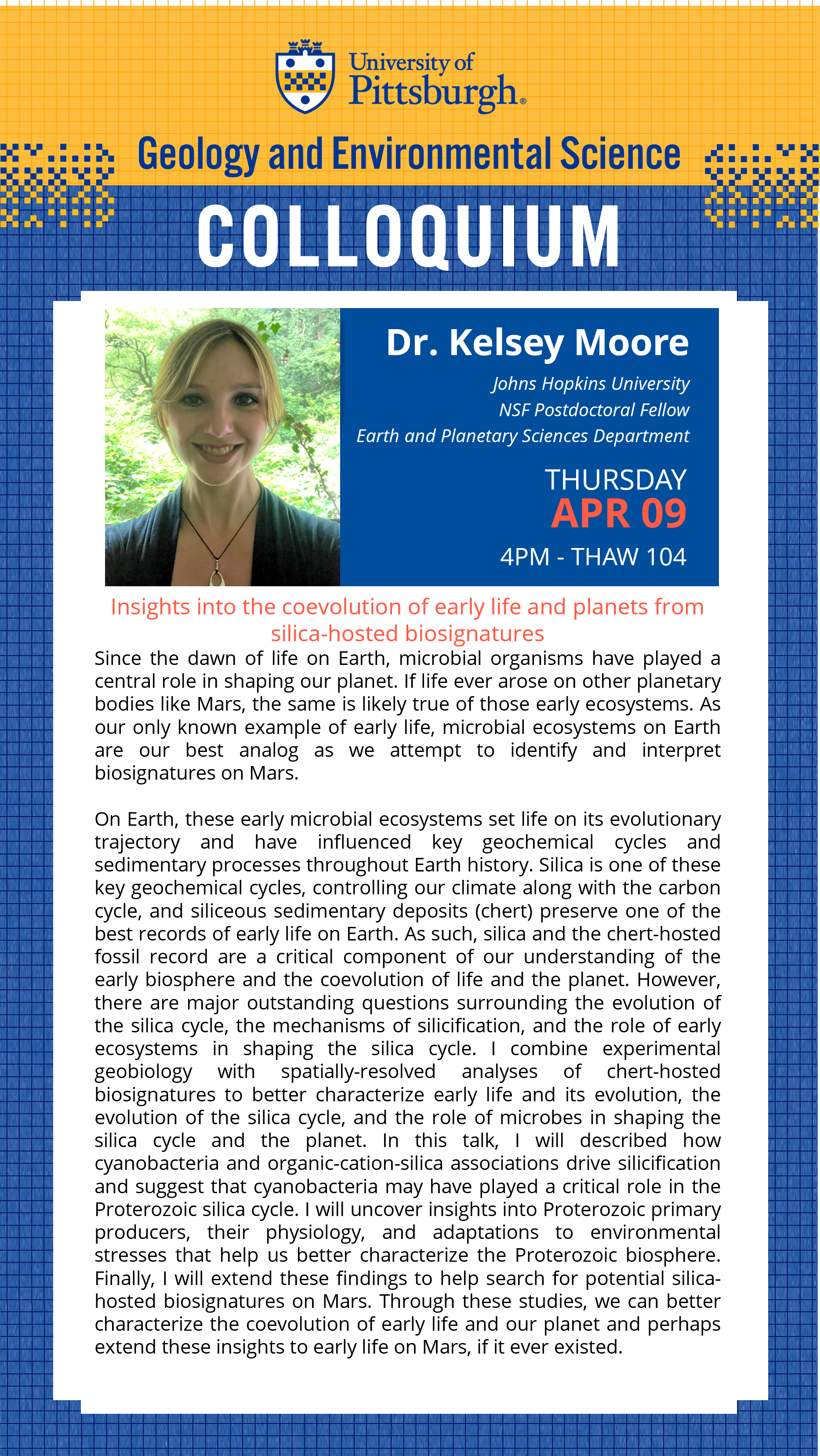
Dr. Kelsey Moore [NSF Postdoctoral Fellow, Johns Hopkins University]: Insights into the coevolution of early life and planets from silica-hosted biosignatures - Apr 9, 2026
University of Pittsburgh, Department of Geology & Environmental Science Colloquia, Fall 2025
Dr. April Abbott [Assistant Professor, Coastal Carolina University]: Impact of Marine Authigenic Clay Formation on Oceanic Trace Element Budgets - Sep 25, 2025

Dr. Katherine Grant [Staff Scientist, Lawrence Livermore National Laboratory]: Organic carbon preservation across scales: how rock derived organic carbon influences the modern carbon cycle - Oct 30, 2025

Dr. Peter Fawcett [Associate Dean for Natural Sciences and Mathematics | Professor, Department of Earth & Planetary Sciences, University of New Mexico]: A 1.5 million-year long record of climate, ecosystem, and dust changes in SW United States from Stoneman Lake, AZ - Nov 13, 2025

Climate of South America workshop, Fall 2019
Magaly Koch. Center for Remote Sensing Boston University. Food and Water Security in Arid Regions: Remote Sensing of Water Availability in Egypt Under Changing Conditions. March 28, 2019.
David Brezinky. Maryland Geological Survey. Influences of climate on Late Devonian Depositional Systems of the Central Appalachians. March 7, 2019.
Matthew Finkenbinder. Environmental Engineering and Earth Sciences, Wilkes University. When was it Wet, When was it Dry, and Why: A Holocene Climate Record from the Northern Rocky Mountains of Montana. March 5, 2019.
Jasmine Saros. Climate Change Institute, University of Maine. Paleo and Contemporary Perspectives on Climate Driven Ecosystem Change in West Greenland. February 6, 2019.
Lesleigh Anderson. Geosciences and Environmental Change Science Center United States Geological Survey. Holocene Hydroclimate and Drought in Western North America: Patterns and Variability Indicated by Isotope Proxies of Paleoenvironmental Water, Alaska and Alpine Colorado. November 1, 2018.
Raghumani Yengkhom Singh. Department of Earth Science Manipur University, India. Vegetation History, Monsoonal Fluctuations and Anthropogenic Impact During the Last 2330 Years from Loktak Lake, Manipur, Northeast India. July 3, 2018.
Alexander Wolfe. Department of Earth and Atmospheric Sciences University of Alberta. Exceptional Polar Amplification of Eocene Climate Under Modest Greenhouse Gas Forcing. April 12, 2018.
Colin Kelley. The Center of Climate and Security, Columbia University. Climate and Security: The Complex Relationship between Vulnerability and Weather and Climate Variability and Change. April 11, 2018.